
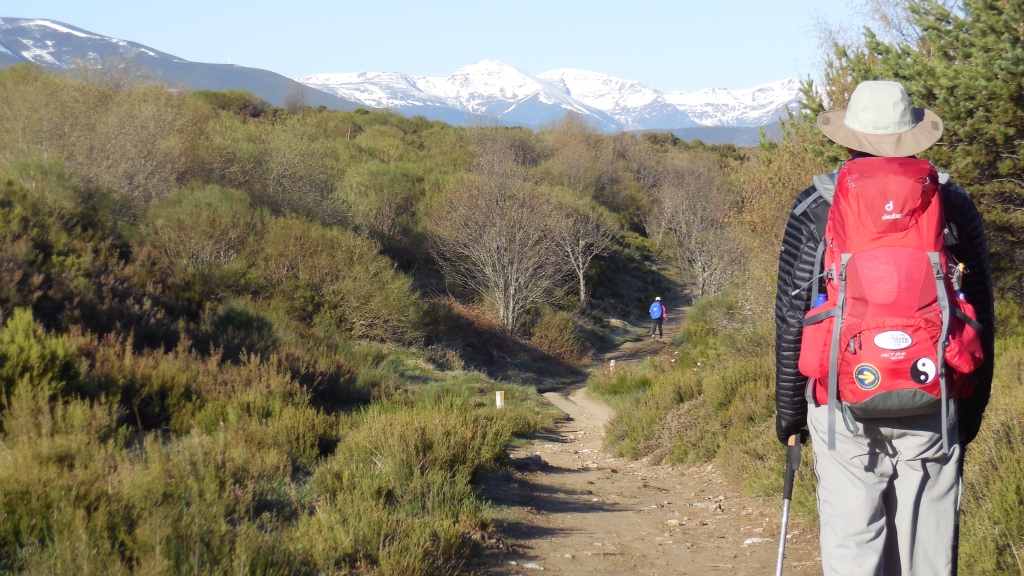
More than three weeks and 300 miles since we left Pamplona on April 11, there is a rhythm to most of our days.
We are up by 6 or 6:30 most mornings and, if available, coffee and breakfast are first. Usually, a bar will offer tostada (big piece of toast with jam and butter) or, if we are lucky, tortilla (egg frittata, usually with potatoes).
Otherwise, we are on the trail by 7 and looking for a village bar up the trail for breakfast. There have been days when breakfast waits until 9 or even 10 because no place is open or there is no village for awhile.
We try to pack things like banana, orange, yogurt and/or peanuts as backups and snacks. A large chocolate bar has become a staple. We buy these at a tiny store in a village. These are usually closed on Sundays and during siesta, so we have to plan ahead.
If we have had breakfast, we stop at a bar mid-morning for our second coffee, usually sitting outside so we can greet passing pilgrims, who sometimes join us.
Camino lesson: Always use the bathroom before leaving the bar. There are virtually no public bathrooms (other than behind shrubs or trees or not) on the Camino.
Our lunch is a picnic along the way. Sometimes, we find a Camino rest stop with picnic tables. You can hear our sighs of relief as we remove our shoes and socks.
Since we have reduced our distance to about 12-13 miles a day, we are looking for a place to stay by 2 or 3 p.m. Our guide lists the albergues (hostels) and a little information about each one. For the past three nights, though, we have stopped at hostals, which are hotels. They cost from 25€ to 50€ a night and have been quite nice. I am trying to avoid the big dorm rooms; Sue is more willing to tough it out.
This afternoon, Saturday, we are in a wonderful, quaint place with a terrace and clothesline outside our room. It is run by a friendly, English-speaking Dutch woman in a riverside village. And, Sue has a bathtub! All for just 38€.
We have never had a problem finding a bed.
After a hot shower, we rest for awhile, then explore the village and find a bar to have a drink. Often, we join other pilgrims. This was especially fun during the first two weeks of the journey, but our good friends we met at the beginning are no longer on the Camino.
For dinner, we normally have the pilgrim's meal where we are staying, usually with fellow Camino trekkers. This is a three-course meal with a several choices for each course. Most of the time, the food has been alright, but not great. The wine, especially during the first two weeks, has been very good. Lately, the food has been much better, the wine not as good. Pilgrim meals come with wine and cost from 8€ to 10€. (A euro is about $1.30.)
Another routine is appreciation for this beautiful country. I often find myself thinking that this experience is too good to be real.
The Camino has tested our limits. Pain is a given every day.
But, the rhythm of the Camino has a beat unlike any other journey.


 carryoncouple
Leave a comment